How Wick returns repricing value to liquidity providers
Liquidity providers supply the inventory that makes a market possible. When prices diverge across venues, arbitrageurs buy where an asset is cheaper and sell where it is more expensive. This brings prices closer together. LPs receive swap fees, but the profit left after fees and execution costs usually goes to the arbitrageur.
At Wick, we combine dynamic fees with a preferred internal arbitrageur and return captured revenue to the LPs involved. Fees compensate LPs when traders use their inventory. Internal arbitrage captures the remaining spread across connected markets. Bringing the two together lets LPs participate in more of the value generated by repricing.
Fees that adjust to market conditions
In a concentrated-liquidity AMM, LPs place inventory across a range of prices. Trades move through that liquidity and change the pool's price. External arbitrageurs keep the pool connected to other markets, but they act only when the price difference covers the costs of both trades.
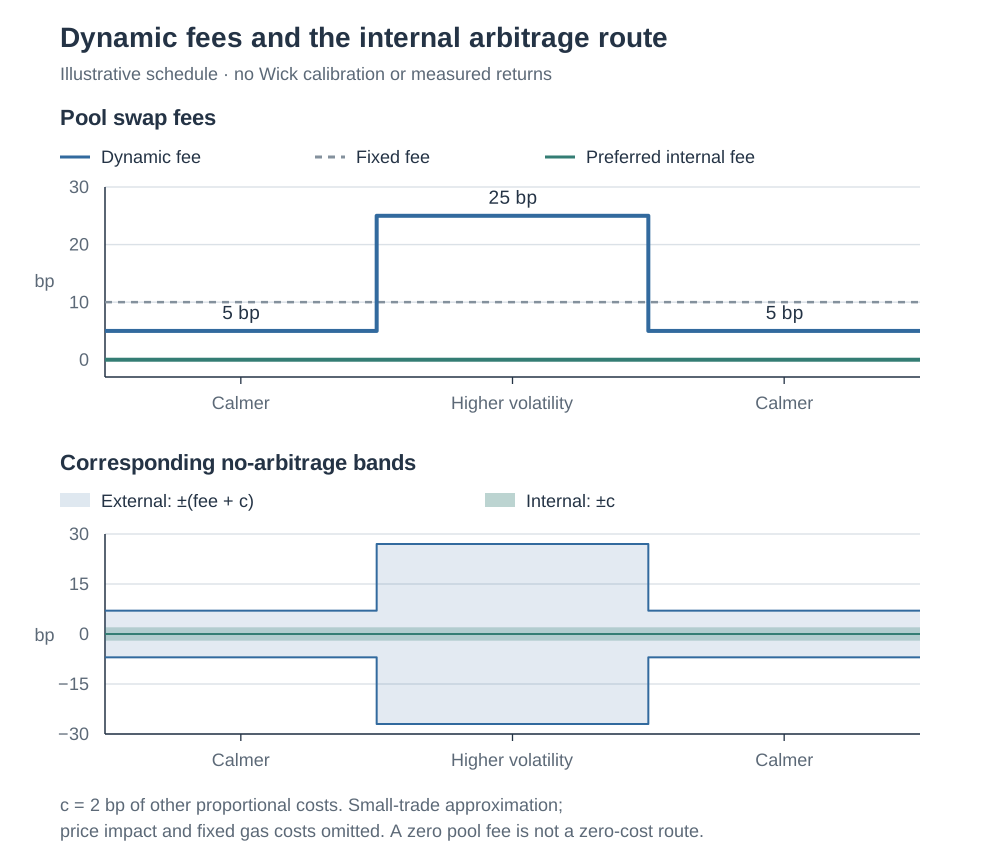
Fees therefore create a no-arbitrage band: a range of price differences too small to close profitably. A higher fee increases the compensation LPs receive on a given trade, but it also widens this band. Some smaller corrections stop being profitable, and ordinary trading becomes more expensive.
A fixed fee has to serve both quiet and volatile markets. When prices move quickly, it may leave too much of the repricing value to arbitrageurs. When conditions settle, it may charge more than the risk warrants. Dynamic fees let us adjust this balance. They are one part of Wick's design; the other is who performs the arbitrage and who receives the proceeds. (Wick's AMM design)
Price correction with zero internal pool fees
Wick's preferred arbitrageur pays zero internal pool fees. Ordinary trades still pay the applicable dynamic fee. This allows the internal operation to pursue price differences that would not cover an outsider's posted fee. We can raise fees when supplying inventory becomes more costly without imposing that same hurdle on internal price correction. (Arbitrage documentation)
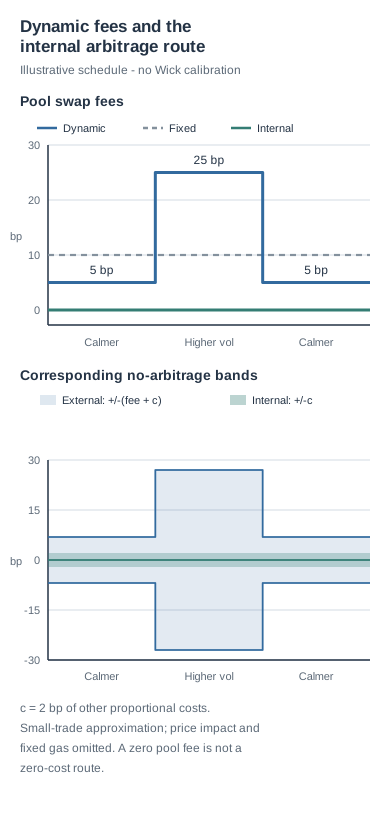
Zero internal pool fees do not make execution free. Fees at the other venue, gas, latency, and execution risk still matter. The gain is a lower threshold for correcting prices, as the first figure illustrates.
The proceeds then return to liquidity. Under Wick's LP incentive path, arbitrage profits buy WICK on the market, and the purchased tokens fund incentives for LPs in the pools the arbitrage touched. These incentives sit alongside swap fees and use captured revenue rather than newly minted WICK on this path. Their contribution to LP returns is the value actually received, including the effect of token prices and payment timing. (LP incentive routing)
Capturing value from connected markets
There is a further benefit to internalizing arbitrage. The trade changes prices on both sides: buying on the cheaper venue moves its price up, while selling on the more expensive venue moves its price down. Both venues can contribute to the arbitrage surplus. This applies to trading against a CEX orderbook as well as against another on-chain pool.
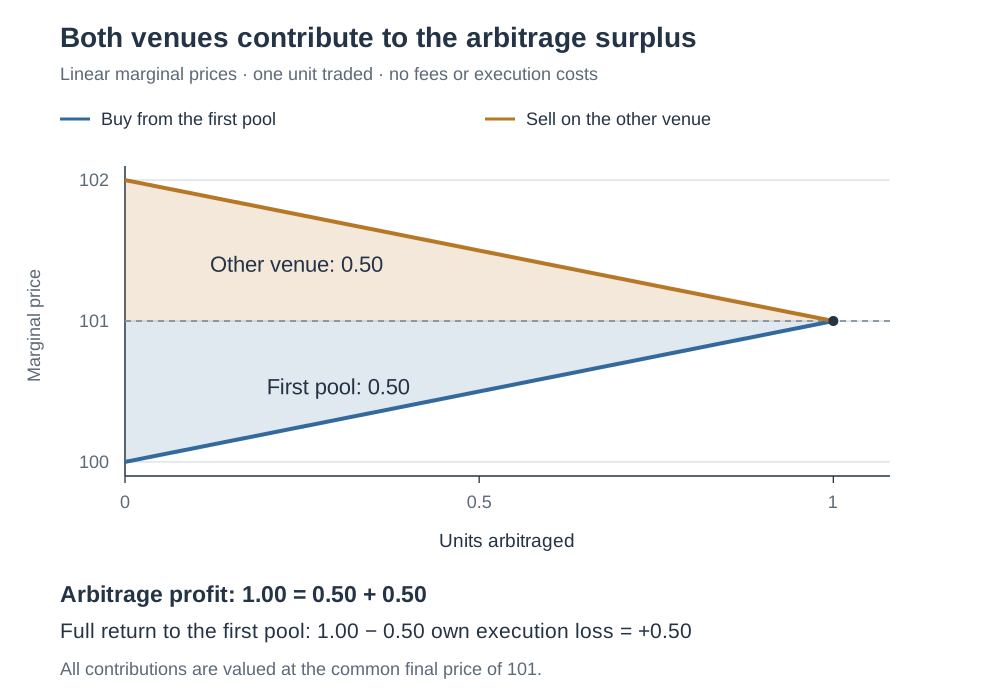
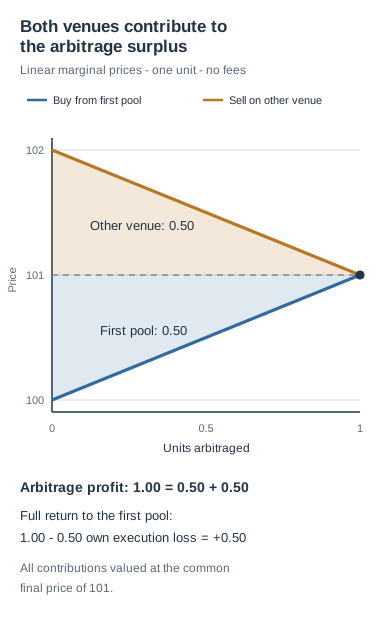
Take a simple example with linear price impact and no fees or execution costs. Buying one unit moves the first pool from 100 to 101 and costs 100.50. Selling it on the second venue moves that price from 102 to 101 and yields 101.50. The arbitrageur makes 1.00. At the common final price of 101, each venue contributed 0.50.
If the full profit returns to the first pool, it covers that pool's 0.50 execution loss and adds another 0.50 for its LPs. Returned arbitrage proceeds can therefore exceed the originating pool's own loss. How much comes from the other venue depends on relative depth and the valuation benchmark. The contribution may be small against a very deep CEX and larger against an on-chain pool of comparable depth.
Auctions and internal arbitrage
Angstrom also returns repricing value to LPs, but uses an auction to do so. Arbitrageurs bid for a fee-free trade against the pool, and the winning bid goes to LPs. With competitive bidding, the auction can return a large share of the opportunity, including surplus from other venues. (Angstrom's design)
Wick performs the arbitrage internally. That gives us the chance to retain the margin an auction winner would otherwise keep, provided our execution is competitive. Dynamic fees recover part of the value through trading; the internal operation captures what remains available and directs revenue toward LP incentives. Execution costs and the amount actually returned determine the benefit.
How Wick compares with Metric
Metric changes the repricing process itself. Its active pools place liquidity in percentage bands around a reference price. When that reference moves, the quoted prices move with it, without requiring a swap. Updating the reference does not itself change the pool's token balances; subsequent trades do. LPs earn from the spread when their liquidity is used. (Metric's architecture)
Wick keeps corrective trading as part of price alignment and seeks to return its value to LPs. That includes both compensation through dynamic fees and captured arbitrage proceeds. As the two-venue example shows, those proceeds can contain value contributed by the market on the other side of the trade.
Both designs can adjust trading terms to market conditions. Metric's public price-provider code supports adjustable bid–ask spreads and rejects stale oracle inputs. Wick combines dynamic pool fees with preferred internal execution. The distinction is how each design updates prices and turns trading activity into LP income. (Metric's price provider)
| Mechanism | Wick | Metric |
|---|---|---|
| Price alignment | Corrective trades move the pool price | A reference update shifts quoted prices |
| Inventory during repricing | Corrective trades exchange tokens | A reference update alone leaves token balances unchanged |
| LP income | Swap fees and returned arbitrage proceeds | Spread earned on executed trades |
| What must work well | Fee setting, arbitrage execution, and revenue return | Reference pricing, quoted spreads, and inventory management |
This gives us two different ways to improve LP economics: reduce the need for corrective trades, or capture more of their value. Their relative appeal depends on the price path and the trading income each pool can earn.
When recovered value can exceed IL
This is where the distinction between impermanent loss and loss-versus-rebalancing matters. IL compares the ending liquidity position with holding the starting assets. LVR accumulates execution losses relative to rebalancing the same inventory strategy at market prices. In the basic fixed-liquidity model, IL depends on where the price ends, while LVR depends on the path it took. The two can be very different on a particular trajectory. (Alexander and Fritz)
Suppose prices move back and forth and finish close to where they started. Endpoint IL can be small, while repeated price corrections generate fees and arbitrage opportunities along the way. If enough of that value returns to LPs, it can more than cover IL. For a fixed inventory strategy, a simplified comparison with holding is:
≈ r LVR − IL
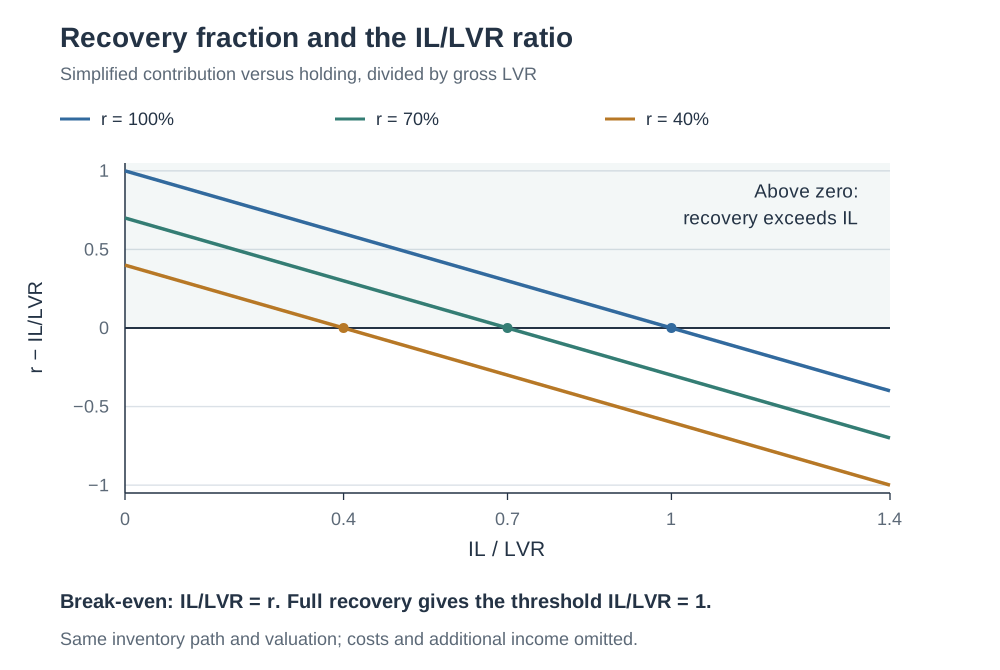
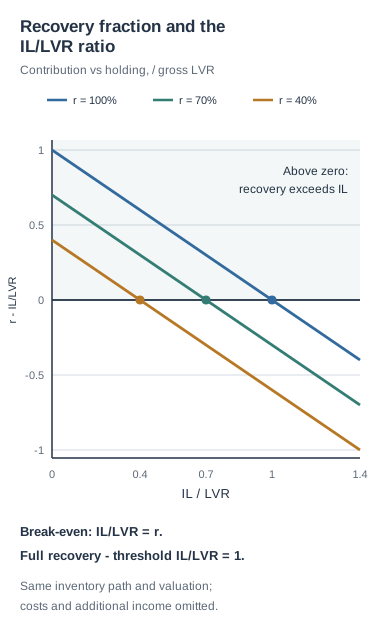
Here, r is the fraction of the pool's gross LVR recovered for LPs through fees, rebates, or auction payments. Losses and recoveries use the same valuation convention, and recoveries are accounted for separately from the inventory position. Operating costs and income from other venues are left out of this expression.
With full recovery, the condition is IL/LVR < 1. With partial recovery, it becomes IL/LVR < r. This makes the role of the mechanism clear: the more repricing value we return, the wider the range of price paths on which recovery can cover IL. Ordinary trading income and surplus from other venues can improve the result; costs reduce it.
In sustained directional markets, we would expect Metric's approach to have an advantage when its reference stays current: it can follow the price without requiring the inventory transfers that correct a fixed AMM curve. Such a curve progressively sells the rising asset or accumulates the falling one, and the resulting IL can exceed recovered arbitrage income. (Alexander, Lambert and Fritz)
When prices reverse often and IL is small relative to LVR, Wick has a different source of strength. Repeated corrections create revenue that we aim to return to LPs, while endpoint IL can remain small. The IL/LVR condition tells us when recovery can beat holding. A comparison with Metric must also count its spread income and inventory P&L. The appendix will compare those returns with Wick's fees and net returned arbitrage proceeds under matched assumptions.
This is the principle behind Wick. Dynamic fees compensate liquidity as trading conditions change. The preferred arbitrageur can correct smaller discrepancies without paying an internal pool fee. Returning the proceeds lets LPs share in the remaining arbitrage value, including value contributed by other markets.
For LPs, that means access to both swap-fee income and the proceeds from keeping markets aligned. The Wick whitepaper describes the wider design. The appendix will set out the accounting and simulations needed to quantify the comparison.